
There has been much talk over the summer about the future of AI and what it means for workers, consumers and companies alike.
Whereas a year ago, people were “ blindly optimistic” about what AI meant for the economy and the markets, there is now a degree of scepticism and pushback.
The pushback is based on environmental and social concerns, around what data centres mean for the communities that host them. Another question that's frequently being asked is: Will their presence boost or damage the economies in those communities, particularly after the construction stage is finished?
For traders, the concerns are more about the size of data centre capex and the amount of money that some of the biggest companies in the US are borrowing to fund it. Another concern is the nested and interconnected nature of deals between major players in the space.
Spending is growing
Data centre Capex spend is now expected to surpass $1.0 trillion by the end of 2027 and to reach a total of $5.50 trillion by 2030, according to data from JPM Asset Management,
Increasingly, hyperscalers and other firms are turning to the debt markets to raise money. According to research by Vanguard, the average debt issuance from the hyperscalers between 2020 and 2024 was around $35.0 billion per annum.
In 2025, that figure rose to $93.0 billion, and as of mid-August, these firms have issued $132.0 billion of new debt. Estimates for the total of new borrowing in 2026, by the wider AI ecosystem, range between $300.00 and $500.00 billion.
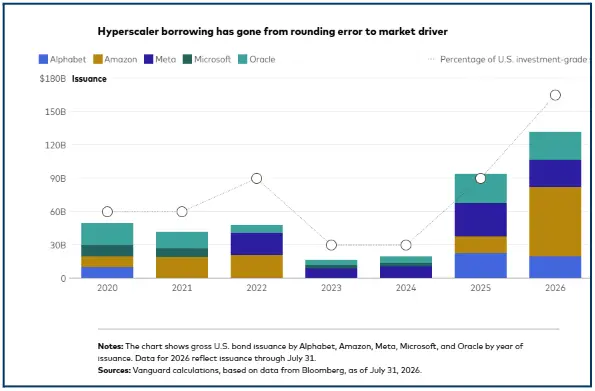
Source: Vanguard
Costs are rising, and for some more than others
The increased level of debt issuance has meant that the cost of new borrowing for these companies has risen, but not by that much. Of course, many of the hyperscalers have huge cash-generative businesses which can support and service their borrowing.
As such, their credit ratings are not under threat, and the strongest borrowers can still secure attractive terms for new money.
This may not last, however, as Oracle (ORCL US) has seen the cost of its new borrowing rise above the sector average, because it hasn't got the same cash flow and balance sheet strength that’s enjoyed by some of its rivals.
Meta Platforms (META) has also seen its borrowing costs rise for similar reasons; that is, the scale of its planned expenditure and the borrowing to fund it has the potential to weaken or even damage its balance sheet.
This is despite the firm having annual revenues of almost $201.00 billion,30.0% profit margins and +194.0% earnings growth in the last 5 years.
I think some of these concerns are genuine, and the questions they raise need to be answered.
An AI IPO and sector divergence
The proposed IPO of AI operator Anthropic could provide some answers, at least as far as sentiment in the markets is concerned.
Can it achieve a multi-trillion-dollar valuation despite being unprofitable, and at the heart of many of the biggest deals, with suppliers across the AI ecosystem?
Talk in the markets is that the deal has been pushed back to mid-October, with a listing likely after the US midterm elections on November 3rd.
Those concerns might help to explain why the Magnificent 7 stocks haven't been among the best performers over the last month, or the year to date
The charts below show us that high beta names have been the top performers in the S&P 500, over both a 1-month and 12-month period.
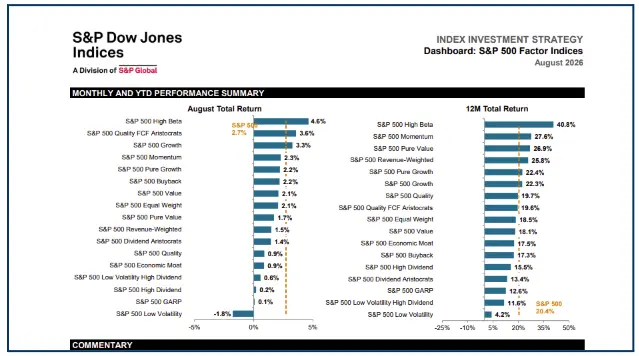
Source: S&P DowJones
Indeed, on this chart (see below), high beta is the only game in town for those looking for excess returns compared to the broader market. Or in other words, it's the only factor or investment style that's in the top right-hand quadrant of the chart.
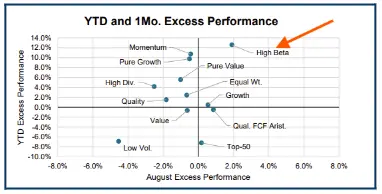
Source: S&P DowJones
What’s in the high beta index?
If we look at the constituents of the high beta index, we find that technology stocks make up almost half of it, but there aren't any hyperscalers among the top 10 holdings.
However, there are plenty of stocks that provide the “picks and shovels” to the data centre industry, including memory makers Sandisk, Micron, and Western Digital, and chip designers and manufacturers, Marvel and AMD.
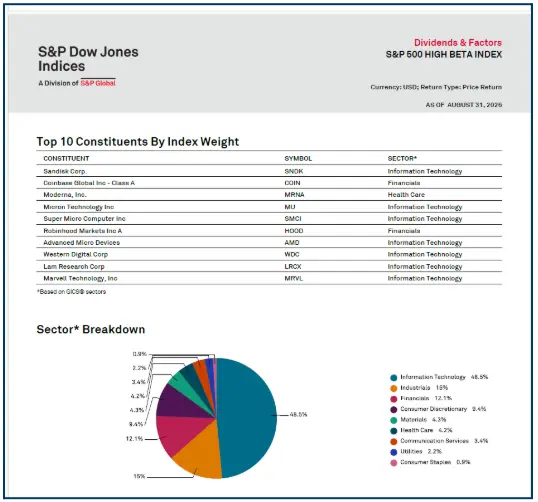
Source: S&P DowJones
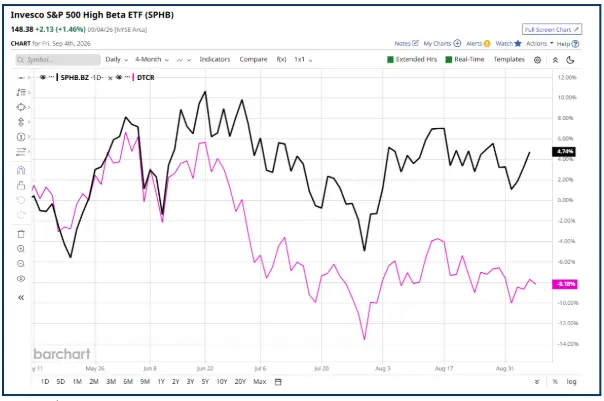
Is this telling us that (at least right now) the equity market would rather benefit from data centre spending and buildout, rather than owning the end product?
That would certainly be one explanation for this chart, which plots the S&P 500 High Beta ETF in black against the DX Datacentre ETF in pink over the last 4-months.
Source: Barchart.com
Overall, I think some caution is warranted simply because there are too many unanswered questions about the future of AI and the data centres that support it - that said, in the near to medium term, AI Capex isn't going away, and that means that suppliers and service providers could see growing sales and profitability for some time to come.
The information provided does not constitute investment research. The material has not been prepared in accordance with the legal requirements designed to promote the independence of investment research and as such is to be considered to be a marketing communication.
All information has been prepared by ActivTrades (“AT”). The information does not contain a record of AT’s prices, or an offer of or solicitation for a transaction in any financial instrument. No representation or warranty is given as to the accuracy or completeness of this information.
Any material provided does not have regard to the specific investment objective and financial situation of any person who may receive it. Past performance is not a reliable indicator of future performance. AT provides an execution-only service. Consequently, any person acting on the information provided does so at their own risk. Forecasts are not guarantees. Rates may change. Political risk is unpredictable. Central bank actions may vary. Platforms’ tools do not guarantee success.