
From a bottom-up perspective, the equity markets are simply a set of stocks that traders and investors choose to own, sell, or even ignore.
From this standpoint, a stock market can look random and disorganised.
Hidden Structure
However, from a top-down view, you can see a lot of structure, and you realise that far from being random, stock markets are highly organised and ordered, usually in a hierarchy such as the one set out below.
Stock Market
└── Market Indexes
├── Country indexes
│ ├── FTSE 100
│ ├── S&P 500
│ ├── Nikkei 225
│ └── DAX
├── Sector & Sub Sector indexes
│ ├── Technology
│ ├── Financials
│ ├── Healthcare
│ ├── Energy
│ └── Utilities
└── Industry / Sub-industry groups
├── Semiconductors
├── Banks
├── Pharmaceuticals
├── Oil & Gas
└── Electric Utilities
Source: Perplexity AI
Stock markets around the world follow a standardised classification system known as The Global Industry Classification Standard, or GICS for short. The system was established in 1999 and covers around 50,000 listed companies globally.
The system originally contained 10 sectors; however, Real Estate was promoted to become a sector in its own right in 2016, having previously been seen as a sub-industry within the broader Financials sector.
The GICS system is overseen by MSCI &S&P Dow Jones, and they conduct annual reviews to ensure it remains up-to-date and relevant.
While indices tend to group companies by geographical location or domicile, sectors categorise them by what the business does to make money.
And that means that traders can analyse and compare stocks that have similar or adjacent interests and characteristics. They can research companies within the same sector and industries, or compare a sector's performance with its peers.
.
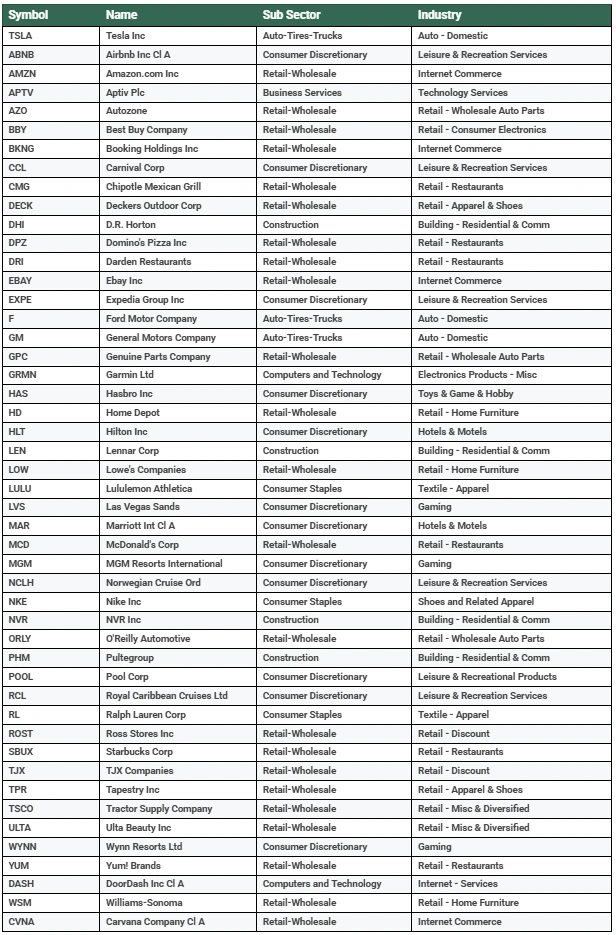
Under GIC's stocks are assigned to a single sector, so there are no overlaps or duplications, though one could argue that the groupings are sometimes contentious. For example, EV Maker Tesla TSLA US lives in the Consumer Discretionary sector, where it sits alongside the likes of McDonald's MCD US, Airbnb ABNB US and eBay EBAY US.
The table below shows the constituents of the S&P 500 Consumer Discretionary Sector, and lists their subsector and industry memberships.
Source:Barchart.com/DarrenSinden
It's a very diversified list at the sector level, but by drilling down to the subsector and industry level, we can
Find similarities between these sector members.
Sector Performance
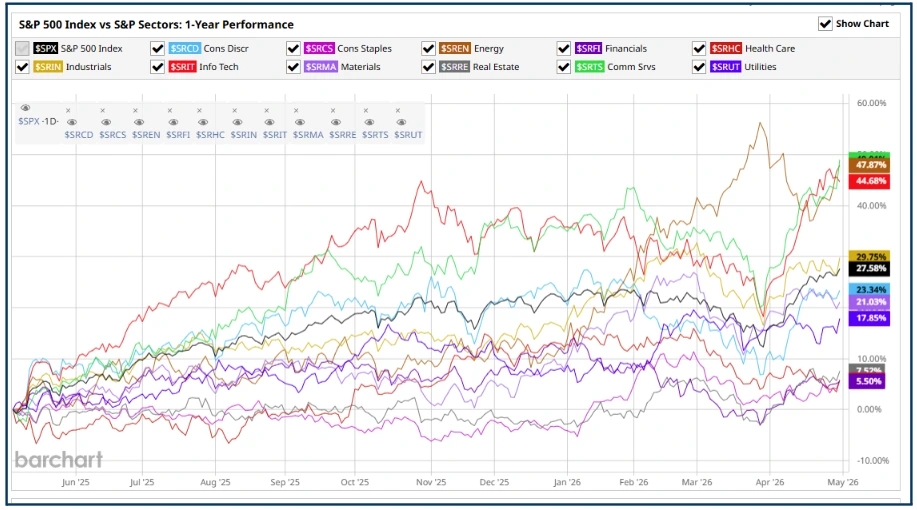
The chart below compares the performance of the 11 S&P 500 sectors with each other and the S&P 500 index itself. Each sector is colour-coded, and the index is shown in black.
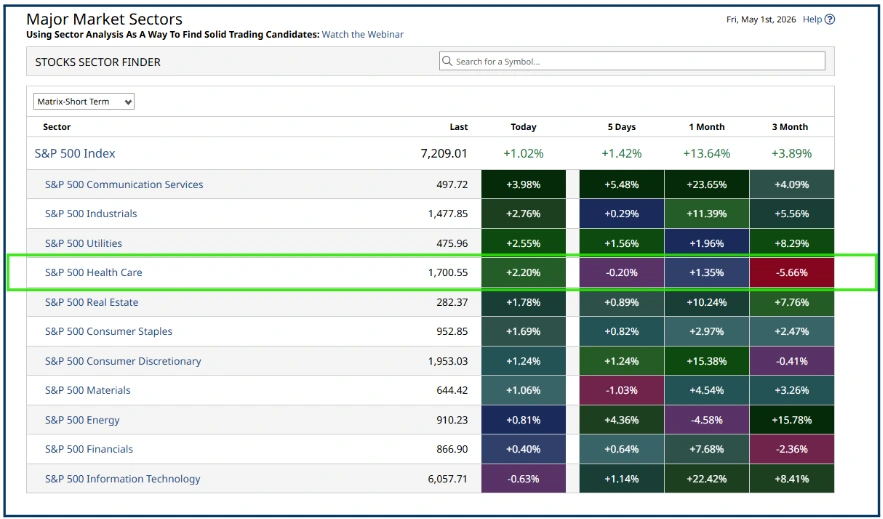
We can take the performance comparison a stage further by using a performance matrix or table such as the one below, which shows us how the 11 sectors have performed over time frames between 3-months down to 1-day.
Source:Barchart.com
Healthy Underperformance
One sector has underperformed its peers, and that is Healthcare. Of course, underperformance creates opportunity as long as the root causes of that underperformance can be changed or overcome.
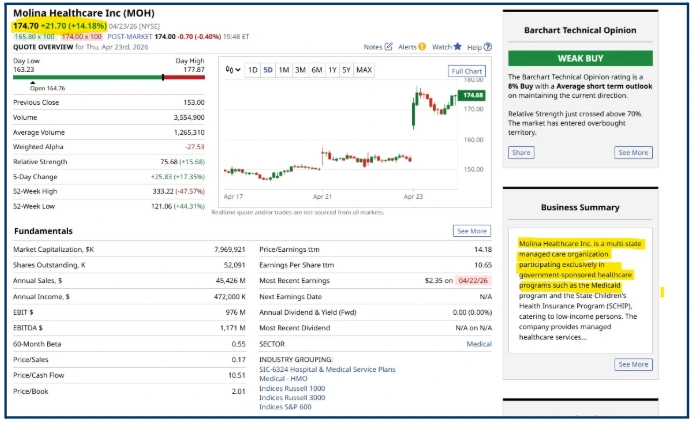
Earnings season was an ideal opportunity for sentiment towards the sector to change, and with that idea in mind, I shared this image and these messages with Idea Factory Members on the morning of April 24th
“This is interesting, a good beat from a stock in a sector that's been under pressure, MOH US Molina Healthcare “
I added:
“Note that it's totally involved in Medicaid, which has been a millstone for others like HUM, US UNH US, so it might be a positive read across”
Source:Barchart.com
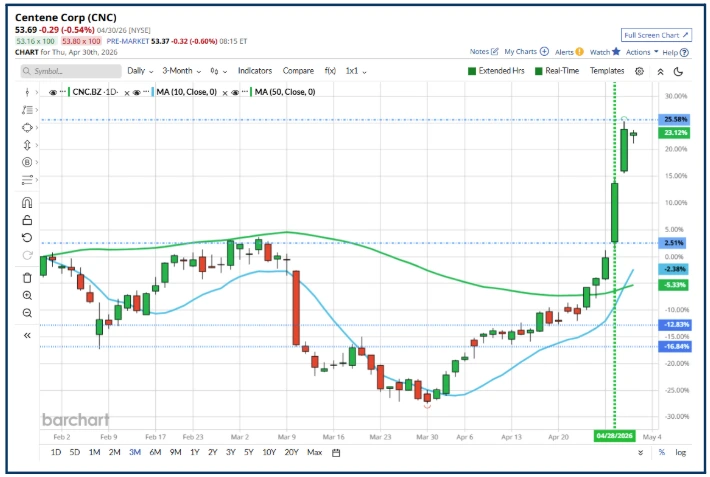
Sector peer Centene Corp CNC US (see below) reported earnings on the 28th of April, the stock rallied more than +20.0% on blowout results and higher guidance.
Source:Barchart.com
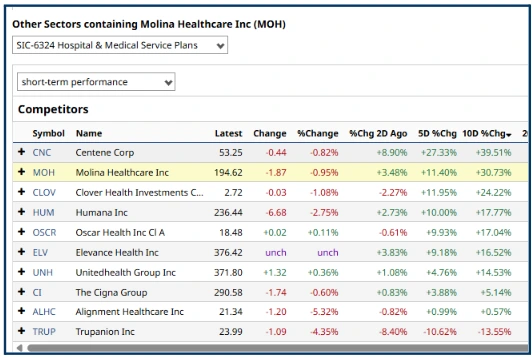
Here are some more of Molina Health's peers in a table that ranks their performance over the previous 10 days.
Source:Barchart.com
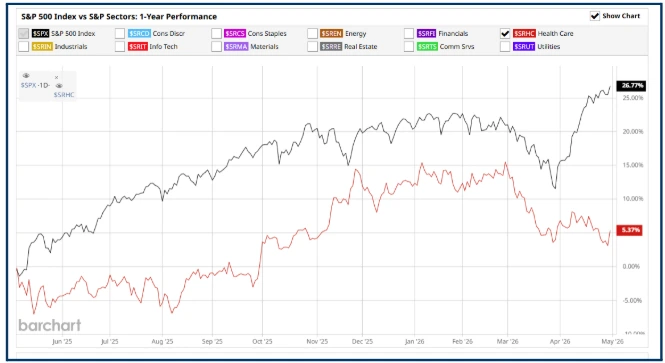
If we go back and compare the Healthcare sector against the S&P 500 index over the last 12 months, we find that the index has risen by +26.77% whilst Healthcare is up by just +5.37% in that time frame.
Source:Barchart.com
The question is, could the sector generate further gains and close the gap with the wider index?
The information provided does not constitute investment research. The material has not been prepared in accordance with the legal requirements designed to promote the independence of investment research and as such is to be considered to be a marketing communication.
All information has been prepared by ActivTrades (“AT”). The information does not contain a record of AT’s prices, or an offer of or solicitation for a transaction in any financial instrument. No representation or warranty is given as to the accuracy or completeness of this information.
Any material provided does not have regard to the specific investment objective and financial situation of any person who may receive it. Past performance is not a reliable indicator of future performance. AT provides an execution-only service. Consequently, any person acting on the information provided does so at their own risk. Forecasts are not guarantees. Rates may change. Political risk is unpredictable. Central bank actions may vary. Platforms’ tools do not guarantee success.